——
#LucPaquin #Spirituality #Philosophy #Agnosticism #WorkLifeBalance
——
——
Agnosticism
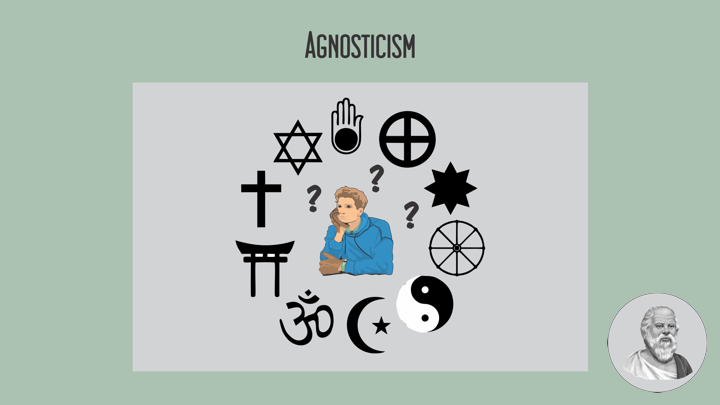
Agnosticism is the view or belief that the existence of God, of the divine or the supernatural is unknown or unknowable. Another definition provided is the view that human reason is incapable of providing sufficient rational grounds to justify either the belief that God exists or the belief that God does not exist. In contrast, the word agnostic refers to a person who neither believes nor disbelieves in a god or religious doctrine. Agnostics assert that it’s impossible to know how the universe was created and whether or not divine beings exist.
To complicate matters, atheists and agnostics are often confused with theists and deists. A theist is the opposite of an atheist. Theists believe in the existence of a god or gods. The word deist refers to someone who believes in God. But a deist believes that while God created the universe, natural laws determine how the universe plays out.
In the popular sense, an agnostic is someone who neither believes nor disbelieves in God, whereas an atheist disbelieves in God. In the strict sense, however, agnosticism is the view that human reason is incapable of providing sufficient rational grounds to justify either the belief that God exists or the belief that God does not exist. In so far as one holds that our beliefs are rational only if they are sufficiently supported by human reason, the person who accepts the philosophical position of agnosticism will hold that neither the belief that God exists nor the belief that God does not exist is rational. In the modern period, agnostics have appealed largely to the philosophies of Hume and Kant as providing the justification for agnosticism as a philosophical position.
As with any identity, specific beliefs depend on the individual. There’s a notion that any belief in a god would be contradictory to agnosticism, but it’s a bit more complicated than that.
Nowadays, the term “Agnostic” is often used, when the issue is God’s existence, to refer to those who follow the recommendation expressed in the conclusion an agnostic is a person who has entertained the proposition that there is a God but believes neither that it is true nor that it is false. Not surprisingly, then, the term “Agnosticism” is often defined, both in and outside of philosophy, not as a principle or any other sort of proposition but instead as the psychological state of being an agnostic. Call this the “Psychological” sense of the term. It is certainly useful to have a term to refer to people who are neither theists nor atheists, but philosophers might wish that some other term besides “Agnostic” were used. The problem is that it is also very useful for philosophical purposes to have a name for the epistemological position that follows from the premise of argument, the position that neither theism nor atheism is known, or most ambitiously, that neither the belief that God exists nor the belief that God does not exist has positive epistemic status of any sort. Just as the metaphysical question of God’s existence is central to philosophy of religion, so too is the epistemological question of whether or not theism or atheism is known or has some other sort of positive epistemic status like being justified, rational, reasonable, or probable. And given the etymology of “Agnostic”, what better term could there be for a negative answer to that epistemological question than “Agnosticism”? Further, as suggested earlier, it is, for very good reason, typical in philosophy to use the suffix “-ism” to refer to a proposition instead of to a state or condition, since only the former can sensibly be tested by argument.
Luc Paquin